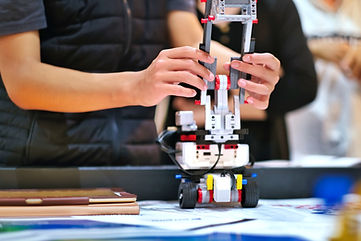
Understanding teachers' lived experiences with physical computing
This website presents findings from a doctoral study that investigates how computing teachers experience the teaching of physical computing in English secondary schools.
Physical computing involves the use of programmable devices, including microcontrollers, sensors, and robotics, which allow students to connect software with the physical world. Although the adoption of these technologies in classrooms is increasing, existing research has primarily concentrated on curriculum design, technical tools, or student outcomes.
In contrast, this study examines teachers' experiences of teaching with these technologies.
The central research question is as follows:
What is the meaning of teachers' lived experiences with physical computing in English secondary schools?
Research approach
This study employs a hermeneutic phenomenological approach.
Hermeneutic phenomenology is a research tradition focused on understanding the meaning of everyday experiences. Instead of conceptualising teaching as a collection of techniques or measurable outcomes, this approach investigates how teachers interpret and understand their professional practice as it occurs.
Understanding develops through a process known as the hermeneutic circle, which involves a continual movement between individual experiences and the broader contexts in which they take place. Through repeated analysis of teachers’ accounts, additional layers of meaning are revealed over time.
Participants and conversations
To gain unique insights, the study engaged five Heads of Computing Departments from English secondary schools.
Each participant participated in a series of extended interviews conducted over thirteen months. This longitudinal approach enabled teachers to revisit prior experiences, identify patterns in their professional practice, and articulate the evolution of their pedagogical approaches across diverse contexts. The following dimensions emerged through reflective discussion:
During these interviews, teachers discussed multiple dimensions of teaching physical computing, including embedding hardware and programming into classroom instruction.
-
responses to technical failures and unanticipated outcomes
-
support provided to students during debugging and experimentation
-
mentorship of colleagues and trainee teachers
-
navigation of curriculum expectations and accountability pressures
These discussions elucidate how physical computing is enacted within the practical realities of school environments, demonstrating the intersection of classroom instruction, departmental responsibilities, institutional structures, and professional relationships.
The interviews formed the foundation for an interpretive process. Through iterative engagement within the hermeneutic circle, teachers' narratives were synthesised into forty-two crafted accounts that illuminate the experiential dimensions of classroom practice.
These accounts integrate teachers' experiences of classroom instruction, mentorship, leadership, and institutional accountability. They document instances of frustration, care, creativity, and adaptation that influence the sustainability of physical computing within schools.
This interpretive process revealed recurring experiential structures. These patterns demonstrate how teachers address the technical demands of physical computing, engage in relational support for students and colleagues, and respond to institutional conditions shaping classroom practice.
Collectively, these crafted stories provide a deeper understanding of how physical computing pedagogy develops within the context of everyday school life.
Crafting the stories
A total of forty-two crafted stories were developed from these interviews, with seventeen selected for analysis throughout the thesis.
Crafted stories are narrative accounts that integrate teachers' words, experiences, and contexts into coherent descriptions of professional practice. Each story documents a moment in which the teaching of physical computing emerges through interactions among teachers, students, technologies, colleagues, and institutional expectations.
The stories were developed through sustained engagement with interview transcripts, enabling interpretation of teachers' experiences within the broader contexts of their professional work. This process aligns with the hermeneutic-phenomenological approach of the study, wherein understanding emerges through iterative movement between individual experiences and the wider meanings they disclose.
This approach enables the crafted stories to illuminate the lived experience of teaching physical computing in secondary schools.
Interpreting the stories
Interpretation was developed through repeated engagement with crafted narratives, guided by the hermeneutic circle. In this process, understanding deepened through movement between discrete experiences and the broader patterns they revealed.
Recurring structures of experience became apparent across the narratives.
These patterns elucidate how the teaching of physical computing unfolds through the intersection of multiple dimensions of practice:
-
Technical systems and classroom practices, such as programming, sensor integration, and hardware troubleshooting
-
Professional relationships, encompassing mentoring, collaboration, and collective problem-solving within departments
-
Institutional expectations, such as curriculum requirements, accountability processes, and organisational structures
-
Professional identity, defined by the commitments, values, and experiences that inform teachers' decision-making in practice
Through sustained interpretive engagement, four interrelated themes were identified: leaping-in, leaping-ahead, mentoring, and professional identity.
Contributions of the study
This study advances the field of computing education in three primary ways.
First, the research foregrounds the lived experiences of computing teachers, illustrating how physical computing pedagogy develops through interpersonal relationships, material interactions, and daily professional judgement.
Second, the study demonstrates the methodological significance of crafted stories as a form of hermeneutic interpretation in computing education research. This method allows for the exploration of teachers' experiences while maintaining the richness and complexity of classroom dynamics.
Third, the research establishes a conceptual framework for care-driven physical computing pedagogy. The findings indicate that teaching physical computing requires ongoing acts of care, including troubleshooting, anticipation, mentoring, and the exercise of professional responsibility.
Reading the thesis
The complete doctoral thesis examines these concepts in greater detail, including the following areas:
-
The theoretical foundations of hermeneutic phenomenology
-
The development of crafted narratives based on teacher interviews
-
A detailed interpretive analysis of teachers' lived experiences
-
The Unified Model of Care-Driven Physical Computing Pedagogy